


Every week, money leaves your business without an invoice, a purchase order or a conversation. It leaves as a claim: a line on a wholesaler remittance that reduces what you get paid. Some of those claims are legitimate. Some are duplicated, mispriced, applied to the wrong period, or charged against a promotion you never agreed to run.
For most Australian liquor suppliers, nobody checks. Not because the team does not care, but because checking means downloading remittances from three portals, cross-referencing them against invoices, promotional agreements and sales data held in four different spreadsheets, and doing it before the next cycle starts. The claim gets accepted by default, and the margin you negotiated so carefully at the start of the year quietly disappears.
This guide covers what wholesale claims are, where the manual process breaks down, why the Australian liquor market makes claims harder than the overseas advice suggests, and what automation genuinely changes.
What are wholesale claims?
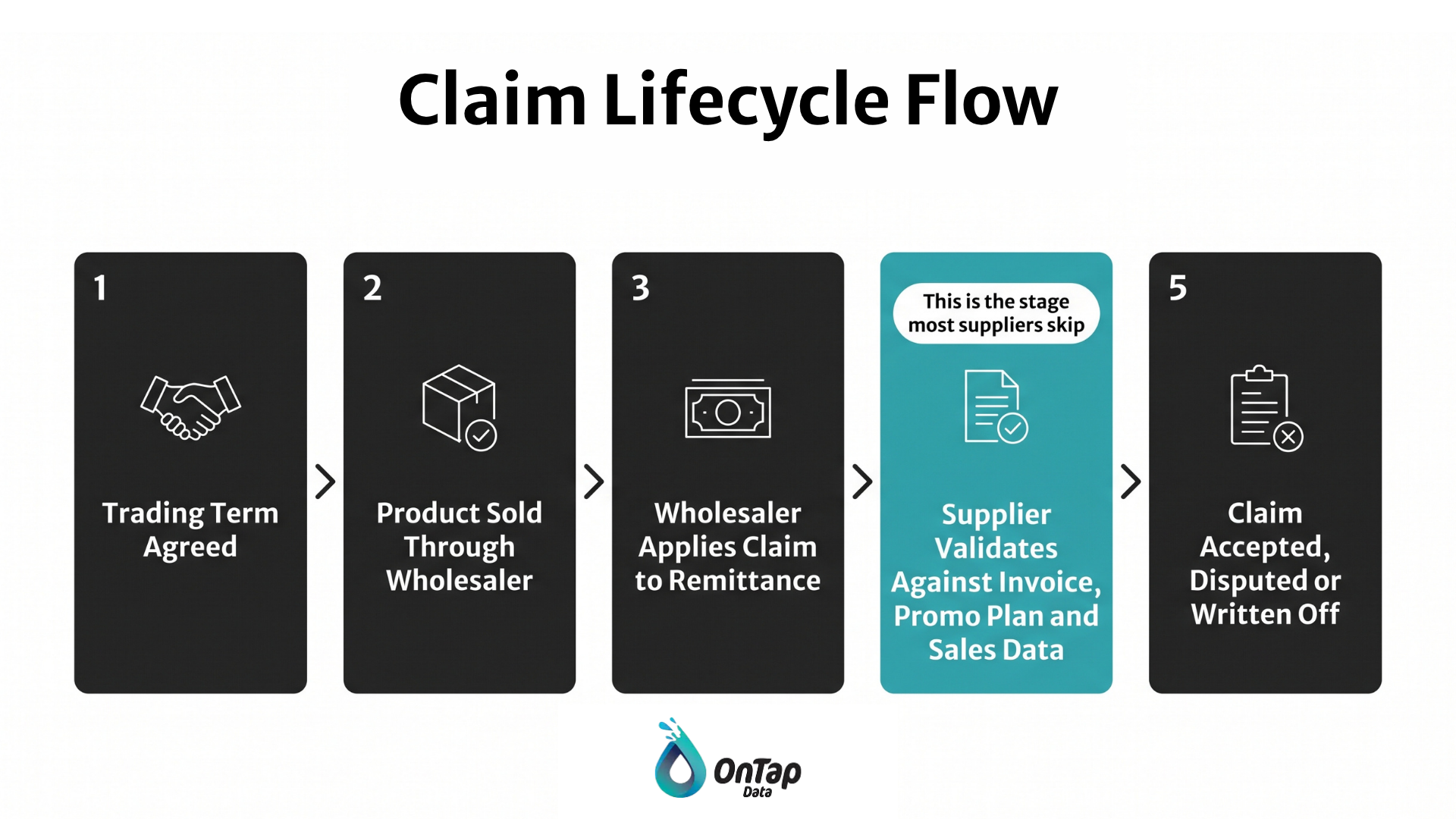
A wholesale claim is a deduction a wholesaler or retailer applies to a supplier’s payment to recover an agreed allowance, promotional cost, rebate or trading adjustment. Instead of paying the full invoice and then invoicing you separately, the wholesaler simply pays you less and tells you why on the remittance.
Claims are not an anomaly. They are the standard settlement mechanism for trade terms across the Australian liquor industry, and they are how the majority of your trade spend actually lands on your P&L. The problem is not that claims exist. The problem is that they arrive as thousands of short, coded lines with almost no supporting detail attached.
Common claim types in the liquor trade
| Claim type | What it settles | Where it usually goes wrong |
|---|---|---|
| Promotional allowance | Funding for a catalogue feature, multi-buy or temporary price reduction | Claimed at the wrong rate, or on volume outside the promotional period |
| Deferred discount (DDA) | An agreed per-case amount paid after the sale | Applied to cases that were never sold through, or double claimed with an off-invoice deal |
| Off-invoice allowance | A discount taken at the point of purchase | Claimed again later as a rebate on the same volume |
| Volume rebate | Growth or turnover targets built into annual trading terms | Calculated on gross rather than net volume, or against an outdated target |
| Ullage, breakage and spoilage | Damaged, leaking or out of date stock | Claimed without evidence, or above the allowance already built into pricing |
| Listing and range fees | Getting a SKU onto shelf or into the range review | Charged for stores that never ranged the product |
| Co-op advertising and media | Catalogue space, shelf ticketing, digital placement | Billed for placements that did not run, or ran in a different cycle |
| Short delivery and shortages | Stock invoiced but not received | Claimed against a delivery your proof of despatch shows was complete |
Is a claim the same as a deduction?
In practice, yes. “Claim” is the term used across the Australian liquor trade, while “deduction” and “chargeback” are the terms used in North American consumer goods literature. They describe the same commercial event: the customer pays less than the invoice and applies a reason code to explain the gap. If you are reading overseas guidance on deduction management, the concepts translate, but the trading structures and the legal protections do not.
How unchecked claims quietly erode margin
Claims erode margin because they are small individually, constant in volume, and almost never challenged. A single claim of $340 is not worth an afternoon of investigation. Four hundred of them across a year is a different conversation entirely.
The maths is worth sitting with. Take a supplier turning over $12 million in gross wholesale sales, with trade spend running at the industry-typical 15% to 25% of gross revenue. That is somewhere between $1.8 million and $3 million settling through claims each year. If even 3% of that value is claimed in error, duplicated or applied outside the agreed terms, you are looking at $54,000 to $90,000 of margin that was never contested.
Trade spend is the second largest line item on a typical supplier P&L, behind cost of goods sold. It is also the line with the least verification attached to it.
Three things make this leakage particularly hard to see:
- It never appears as a loss. The money is deducted before it reaches you, so there is no bill to query and no cheque to stop. It shows up as slightly lower revenue.
- It compounds silently. A rate that was set incorrectly in a supplier master file keeps being applied every cycle until somebody notices.
- It defeats your ROI numbers. If you cannot separate valid promotional costs from invalid claims, every promotion evaluation you run is built on inflated spend.
Where the manual claims process breaks down
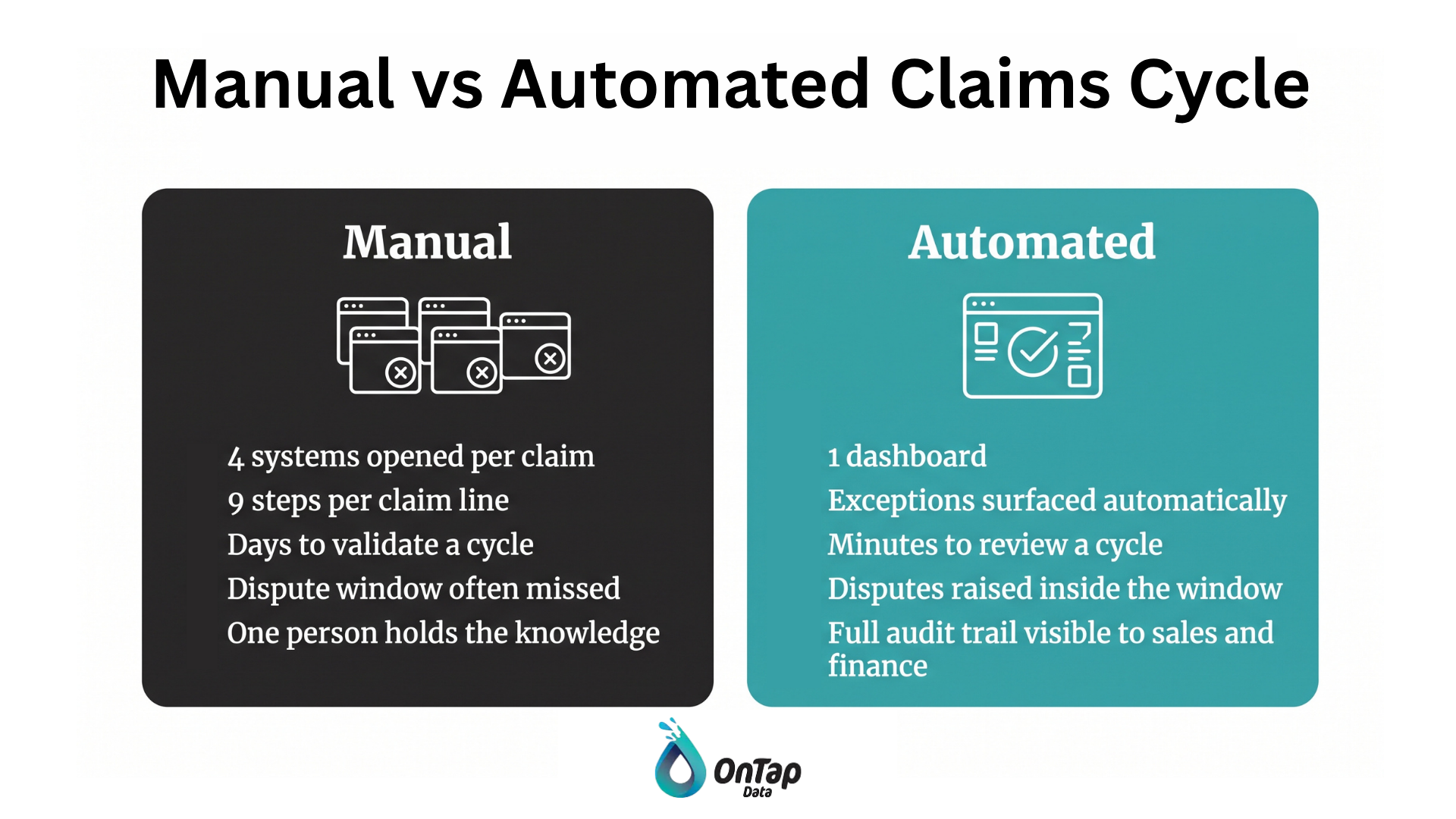
The manual claims process breaks down because validating a single claim requires pulling data from systems that were never designed to talk to each other. Here is what it actually takes to check one line:
- Download the remittance from the wholesaler portal.
- Identify the claim line, the reason code and the amount.
- Locate the original invoice the claim has been applied against.
- Find the promotional agreement or trading term that authorised it.
- Confirm the product, using whatever product code that particular wholesaler uses.
- Confirm the outlet or store, using whatever outlet code that particular wholesaler uses.
- Check the volume claimed against actual sales in the promotional period.
- Check the rate claimed against the rate agreed.
- Decide whether to accept, query or escalate, then record the outcome somewhere the rest of the business can see.
Nine steps, four systems, and a product code that does not match between any of them. Repeat several hundred times per cycle.
The friction points that make it worse
- Codes do not reconcile. Each wholesaler maintains its own product and outlet identifiers. Without a common reference, matching is manual and error prone.
- Scan data and withdrawal data disagree. What sold through the till and what left the warehouse are different numbers, and claims are frequently raised against the wrong one.
- The evidence expires. Claims are often disputable only within a defined window. By the time a manual review finds a problem, the window has closed and the write-off is automatic.
- The knowledge sits with one person. In a business of fifteen people, claims handling usually lives in the head of one finance or operations manager. When they take leave, validation stops.
- Nobody owns the outcome. Sales negotiated the deal, finance received the deduction, and neither has the full picture in front of them.
Why the Australian liquor market makes claims harder
Australian liquor suppliers face a claims environment that generic overseas advice does not describe, for three specific reasons.
You are trading across two very different structures
Managing claims from Endeavour Group or Coles Liquor is a different exercise to managing claims from ALM, Paramount Liquor or ILG. On one side you have a concentrated duopoly with rigid systems and formal processes.
On the other you have a fragmented network of banner groups and independent outlets, each with its own trading terms, its own reporting cadence and its own view of what a promotion was meant to cost. Most suppliers deal with both, simultaneously, using the same small team.
Scan data and withdrawal data are not the same number
Claims are raised against volume, and there are two competing versions of volume. Withdrawal data tells you what left the wholesaler’s warehouse.
Scan data tells you what actually sold through the till. A promotional claim calculated on withdrawals in a period where stock was loaded early, or sold through late, will not reconcile against your own sales records.
Without both data sets standardised and aligned, you cannot prove the discrepancy even when you are certain it exists.
The Food and Grocery Code does not cover you
This is the point most suppliers miss. The mandatory Food and Grocery Code of Conduct came into force on 1 April 2025 and is enforced by the ACCC, applying to grocery retailers and wholesalers with more than $5 billion in annual Australian revenue. It brought written supply agreements, good faith obligations, dispute resolution mechanisms and penalties of up to $10 million to the grocery supply chain.
Alcoholic drinks are explicitly excluded from the Code’s definition of groceries. The ACCC lists food, non-alcoholic drinks, household products, personal care products and tobacco as covered groceries, and specifically names alcoholic drinks among the categories that are not covered.
The practical consequence is direct. A cereal manufacturer disputing a deduction has a Code Mediator, an arbitration pathway and an anonymous ACCC complaints channel behind them. A gin distillery disputing an identical claim has none of that. Your commercial agreement and your own records are the entire basis of your position. Which means the quality of your data is not an administrative concern. It is your only leverage.
What claims automation actually does
Claims automation replaces manual validation with automated matching: it pulls wholesaler remittance and sales data into one place, maps it to a common product and outlet reference, tests each claim against the agreed trading terms, and surfaces only the exceptions that need a human decision.
The word “automation” gets used loosely, so it is worth being specific about the functions that matter:
- Consolidated intake. Remittance and sales data from every wholesaler lands in one system on a consistent cycle, rather than being downloaded portal by portal.
- Standardised mapping. Products and outlets are translated to a single reference so claims can be matched regardless of which code the wholesaler used.
- Automated reconciliation. Invoiced amounts are matched against actual sales to identify discrepancies before they become disputes.
- Rate and period validation. Claimed rates and volumes are tested against the promotional plan, so a claim outside the agreed period or above the agreed rate is flagged rather than absorbed.
- Exception surfacing. The team reviews the claims that failed a check, not all of them.
- A shared audit trail. Sales, finance and commercial see the same claim history, the same evidence and the same outcome.
| Manual claims handling | Automated claims handling | |
|---|---|---|
| Data source | Multiple portals, downloaded individually | Consolidated feeds in one platform |
| Product and outlet matching | Manual lookup across mismatched codes | Standardised against a common catalogue |
| Validation scope | Highest value claims only, if time allows | Every claim line tested |
| Dispute timing | Often after the window has closed | Inside the window, with evidence attached |
| Evidence for a query | Rebuilt from scratch each time | Already assembled and exportable |
| Visibility | Held in one person's spreadsheet | Shared across sales, finance and commercial |
The data foundation most claims projects skip
Automated matching only works if the product and outlet identifiers agree, which is why master data is the precondition for claims automation rather than a follow-up task.
Most claims automation projects stall here. A platform can be perfectly capable of matching a claim to a promotion and still fail, because the wholesaler calls the product one thing, your ERP calls it another, and the outlet is recorded as “Bottle Shop Richmond” in one file and a six digit account number in the next. Matching accuracy is a function of reference data quality, and nothing else.
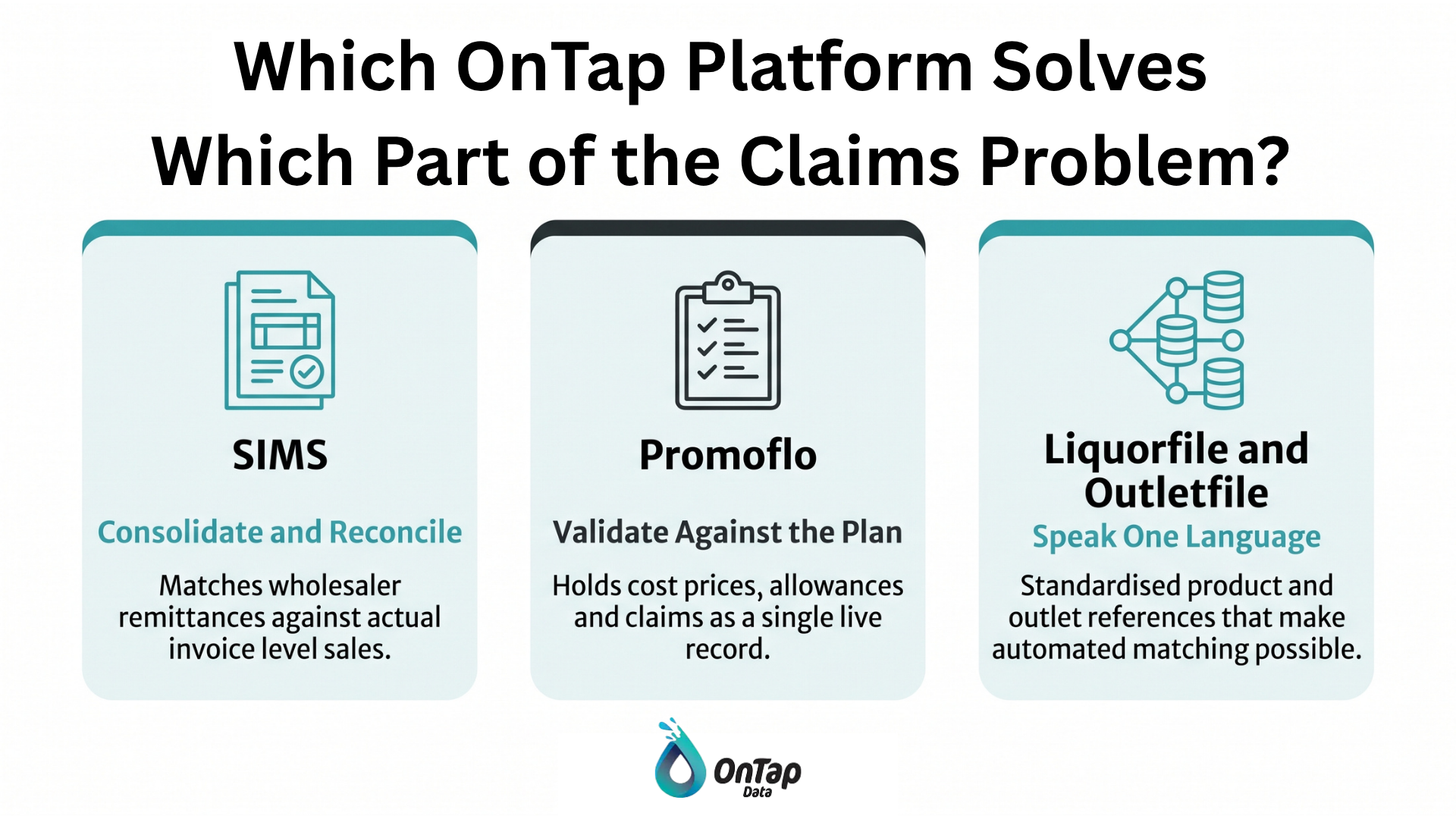
This is why Liquorfile, the Australian industry standard liquor product catalogue, and Outletfile, the national outlet database, do more work in a claims process than they appear to. They provide the common language that lets a claim from one wholesaler be compared against a promotion, an invoice and a sales record that were all created somewhere else.
Before you evaluate any claims process, ask three questions:
- Can we match a product across every wholesaler we trade with, without manual intervention?
- Can we identify the specific outlet a claim relates to, consistently, across all sources?
- Can we tie a claim to the promotional agreement that authorised it, in one step?
If the answer to any of these is no, fix the reference data first. Automation applied to inconsistent data produces confident, incorrect answers faster.
The metrics that prove it is working
Four measures tell you whether your claims process is under control. Track them monthly and the trend line will tell you more than any single cycle.
| Metric | What it measures | What good looks like |
|---|---|---|
| Claim validation rate | Share of claim lines actually checked against terms | Approaching 100%, rather than the top few by value |
| Days claims outstanding | Average age of unresolved claims | Trending down cycle on cycle |
| Query success rate | Share of raised queries that result in a credit | Rising as evidence quality improves |
| Unmatched claim value | Dollar value of claims that could not be tied to an agreement | Falling toward zero as reference data improves |
That last metric is the most useful one, and almost nobody tracks it. Unmatched claim value is the cleanest available proxy for the margin you are handing over without a decision.
A staged path to automated claims
You do not need to solve all of this at once, and attempting to will stall the project. A staged approach delivers a measurable result early and builds from there.
- Months 1 to 3: establish the baseline. Consolidate remittance and sales data from your largest wholesaler into a single view. Standardise product and outlet references. Measure your current unmatched claim value so you have a starting number to improve against.
- Months 4 to 6: validate against terms. Load your promotional agreements and trading terms so claims can be tested against agreed rates and periods automatically. Start raising queries inside the dispute window, with evidence attached. Add your second and third wholesaler feeds.
- Months 7 to 12: close the loop. Connect claims settlement back to promotional planning so the true cost of each promotion is visible while there is still time to act on it. Bring sales, finance and commercial onto the same reporting, and set the four metrics above as a standing monthly review.
08
How OnTap Data streamlines wholesale claims
OnTap Data has spent more than 25 years building the data infrastructure the Australian liquor industry runs on, which is why claims handling sits at the centre of our platforms rather than at the edge.
SIMS, the Supplier Information Management System, connects directly to wholesaler data feeds including ALM, Paramount Liquor and ILG, and pulls invoice level sales data into one platform.
Products are mapped automatically using Liquorfile, outlets are standardised using Outletfile, and remittance claims are reconciled against actual sales to identify discrepancies before they become disputes. It also integrates with CRM platforms including Zoho, Salesforce, Bowimi and Rhino, so the same validated data flows to your field team.
Promoflo handles the other half of the equation. It manages cost prices, supplier allowances and claims in one cloud platform, so the promotional agreement a claim should be tested against is a live record rather than a spreadsheet somebody emailed in March.
When the plan changes, every report updates automatically, which means the number sales quotes and the number finance settles against are finally the same number.
For buying groups managing supplier rebates across a member network, GIMS centralises purchasing data from every member store and every supplier, making rebate tracking and claim reconciliation a reporting exercise rather than an investigation.
"We have uncovered a massive opportunity to be better as a business."
Sazerac
See how Mountain Culture used SIMS to achieve 44% year on year growth and remove hours of weekly manual data work in our case study.
Protect the margin you have already earned
Claims are not going away, and they should not. They are how trade terms settle in this industry. What can change is whether every claim that reaches your remittance has been tested against something, or simply accepted because there was no time to check.
The suppliers who protect their margin are not the ones who dispute the most. They are the ones who can answer, in minutes rather than days, whether a claim matches the agreement that authorised it. That capability is built on consolidated data, standardised references and automated matching. Everything else is negotiation.
Stop accepting claims you have not verified. Turn your beverage sales data into commercial intelligence you can actually use.
Book a 20 minute demo and we will show you what your claims data looks like when it is reconciled.
09
Frequently asked questions
What is a wholesale claim?
A wholesale claim is a deduction a wholesaler or retailer applies to a supplier’s payment to recover an agreed allowance, promotional cost, rebate or trading adjustment. Rather than invoicing the supplier separately, the wholesaler pays less than the invoiced amount and notes the reason on the remittance.
What is the difference between a claim and a deduction?
They describe the same event. “Claim” is the standard term in the Australian liquor trade, while “deduction” and “chargeback” are more common in North American consumer goods. In each case the customer pays less than the invoice and applies a reason code to explain the difference.
Does the Food and Grocery Code of Conduct protect liquor suppliers?
No. Alcoholic drinks are explicitly excluded from the Code’s definition of groceries, so liquor suppliers do not have access to the Code’s dispute resolution and mediation protections when disputing a claim. Your commercial agreement and your own trading records are the basis of any dispute.
What data do you need to validate a claim?
Four things: the original invoice the claim was applied against, the promotional agreement or trading term that authorised it, actual sales volume for the relevant period, and a product and outlet reference that matches across all three. Missing any one of them makes a claim effectively unverifiable.
How much margin do suppliers lose to unchecked claims?
It depends on claim volume and trading terms, but the exposure is straightforward to calculate. Multiply your gross wholesale revenue by your trade spend rate to find the value settling through claims, then apply your estimated error rate. For most mid-sized suppliers the figure is large enough to justify the reconciliation work several times over.
Can claims automation work if our product codes are inconsistent?
Not reliably. Automated matching depends on being able to identify the same product and the same outlet across every data source. Standardising reference data using an industry catalogue is the first step, not an optional extra.


