
On this page
To protect your margins and grow market share, you need to understand exactly what trade spend is, how to calculate it accurately, and why generic fast-moving consumer goods (FMCG) software often fails in the Australian liquor market.
Understanding trade spend in retail
At its core, trade spend is the financial investment a manufacturer or supplier makes to promote their products through retail channels. It is the money spent to incentivise retailers to stock your product, and to incentivise consumers to buy it.
In the liquor industry, this covers everything from funding a “two for $100” multi-buy deal at a local bottle shop, to paying for premium catalogue placement, to covering the cost of an end-cap display.
However, not all trade spend is created equal. To manage your budget effectively, you must categorise your spend into two distinct buckets: working and non-working spend.
Working vs non-working trade spend
Investments the shopper can see
Working trade spend refers to investments that directly influence consumer behaviour and are visible to the shopper. This is the money that actively drives volume and trial.
- Temporary price reductions (TPRs) and discounts
- Multi-buy or mix-and-match offers
- Retailer catalogue and media advertising support
- Preferential shelf placement or end-cap displays
The cost of doing business
Non-working trade spend covers the operational costs of doing business with a retailer. These expenditures do not directly encourage a shopper to pick up your product, but they are often necessary to maintain the retail relationship.
- Spoilage allowances and breakages
- Administrative fees and data sharing costs
- Slotting fees or "pay-to-stay" arrangements
- Short shipment penalties
| Spend category | Primary purpose | Visibility | Examples |
|---|---|---|---|
| Working spend | Drive consumer purchase and increase volume | High — visible to shopper | Discounts, catalogue features, in-store displays |
| Non-working spend | Maintain retail relationships and operational compliance | Low — behind the scenes | Spoilage allowances, admin fees, slotting fees |
Scroll the table sideways to see all columns →
The unique challenge of the Australian liquor industry
If you search for advice on trade spend management, you will find countless articles written for massive, global consumer packaged goods (CPG) brands managing promotions across generic supermarkets. That advice rarely translates to the realities of the Australian beverage market.
The Australian liquor landscape is uniquely complex. Suppliers must navigate a highly concentrated duopoly alongside a fragmented network of independent banner groups. Managing promotions across Endeavour Group and Coles Liquor requires a vastly different approach than running a campaign through Australian Liquor Marketers (ALM) or Independent Liquor Group (ILG).
Furthermore, the data itself is complicated. Suppliers are constantly forced to reconcile scan data — what actually sold through the till — against withdrawal data, which is what left the wholesaler’s warehouse.
When you add complex supplier allowances, state-based pricing variations, and varying store compliance rates into the mix, generic trade promotion management (TPM) software simply cannot cope. Nor can it handle the reporting expectations of buying groups, whose members each want their own view of the same numbers.
The unique challenge of the Australian liquor industry
The foundational metric for evaluating your promotional investment is your trade rate. This calculation helps you benchmark your spending against your overall revenue, ensuring your promotional budget scales appropriately as sales fluctuate.
The standard formula
Trade Rate = Total Trade Spend Gross Sales
- Quarterly trade spend
- $150,000
- Gross sales, same period
- $1,000,000
- Trade rate
- 15%
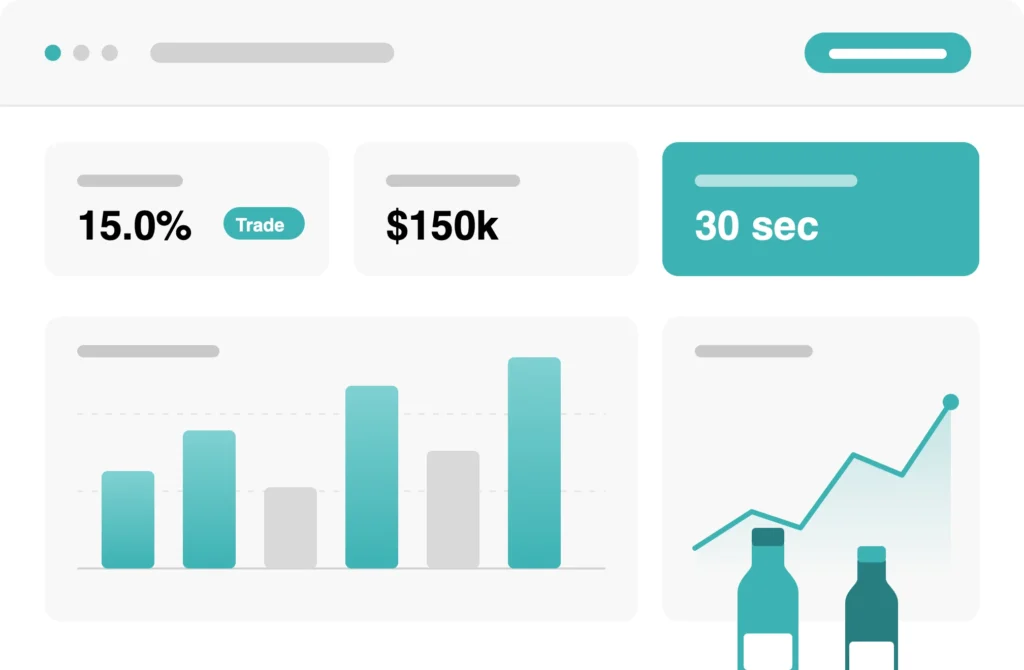
For example, if your brand spends $150,000 on promotions, allowances, and displays in a quarter, and generates $1,000,000 in gross sales during that same period, your trade rate is 15%.
While the formula is simple, gathering accurate data to plug into it is notoriously difficult. If your sales team is tracking promotions in one spreadsheet, finance is tracking deductions in another, and marketing is holding the advertising budget in a third, calculating an accurate trade rate becomes a frustrating, manual exercise.
The hidden cost of spreadsheets
Errors that compound
A missed formula or an outdated cell reference can distort your understanding of a promotion's profitability, leading to poor decisions in the next cycle.
Time you can't recover
Manual data entry drains your team's most valuable resource. By the time data is collated, cleaned, and analysed, the next promotional cycle has already begun.
A closed learning window
Once the next cycle starts, the window for learning and optimisation has closed. You repeat last quarter's mistakes because the answers arrive too late to act on.
Most liquor suppliers and buying groups are losing a full day per banner group, every single cycle, just to spreadsheet assembly.
The team at OnTap Data
How Promoflo transforms trade spend management
To break the cycle of manual reporting, you need a system purpose-built for the nuances of the Australian liquor market. This is where Promoflo changes the game.
Promoflo is a retail promotion management platform designed specifically for Australian liquor suppliers and buying groups. It replaces fragile spreadsheets with a secure, cloud-based single source of truth. When you manage your trade spend through Promoflo, you unlock immediate commercial advantages.
Real-time visibility
Any change to a promotional plan flows instantly through every report. View live volume data, target attainment, and year-on-year performance benchmarks in 30 seconds — rather than waiting days for a spreadsheet to be updated.
Automated compliance and ROI tracking
Promoflo tracks promotion performance across every cycle, automatically calculating store compliance and highlighting opportunities to lift participation. Measure promotional ROI with confidence, knowing the data is accurate and up to date.
Total team alignment
Because Promoflo acts as a single source of truth, your marketing, sales, and finance teams are always looking at the same numbers. This eliminates internal disputes over deductions and keeps everyone aligned on the cost and performance of every campaign.
Stop collecting data and start commanding it
Trade spend is too large of an investment to leave to guesswork and manual data entry. By understanding your working versus non-working spend, calculating your trade rate accurately, and moving away from outdated spreadsheets, you can turn your promotional budget into a true driver of profitable growth.
Stop rebuilding the same promotional spreadsheets every cycle. It is time to turn your beverage sales data into commercial intelligence you can actually use.
Frequently asked questions
What is the difference between trade spend and marketing spend?
How do you measure trade spend ROI?
What is a good trade spend percentage?
Solutions built for the liquor trade
Retail promotion management
Your all-in-one, secure cloud platform for smarter promotions.
Explore Promoflo LiquologyScan and withdrawal data, reconciled
Unlock powerful sales insights with scan-level data.
Explore Liquology GIMSFor groups
The engine behind successful retail buying groups.
Explore GIMS


