

Where Buying Group Promo Cycles Break
A buying group with a thousand-plus member outlets, five banners and offices in six states is not unusual in Australian liquor.
Neither is a single-banner co-operative of ninety stores inside one state. Both run the promotional program out of spreadsheets, email and a shared drive.
The cycle works. It works because two or three people in the group know where every version is and what changed since Tuesday. That is the exposure, not the spreadsheet.
Here is where the cycle breaks, and what each break costs.
Cost Price Accuracy
Promotional retail is set off a cost price. The cost price arrives in a wholesaler price file, and every wholesaler formats theirs differently. Somebody normalises them and rekeys the relevant lines into the planning workbook.
A rekeying error on one line flows straight through to member margin, to the shelf ticket, and to the claim raised against the supplier at the end of the cycle. It is usually found weeks later, by the supplier, during a claim dispute.
Promoflo imports warehouse price files directly. The promoted line carries the cost price from the file, which removes the rekeying step and gives the group one place to answer the question “what did we actually buy this at”.
Multi-Banner, Multi-State
A cycle rarely runs identically across banners. State pricing differs, ranging differs, member participation differs, and the deadlines for catalogue and media differ from the deadlines for shelf tickets.
Held in a workbook, each of those variations becomes a tab or a copy of the file. Version drift follows, and so does the reconciliation work at cycle end.
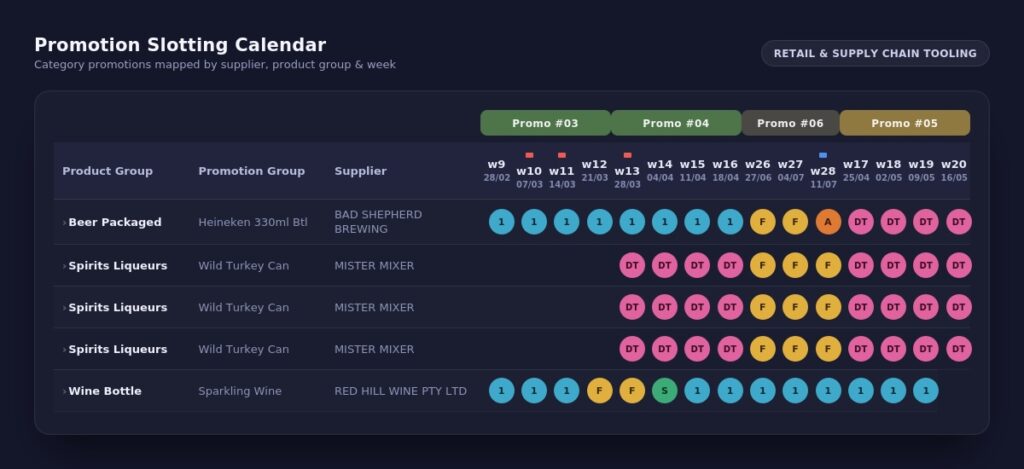
Promoflo’s slotting board holds the whole cycle in one view: which line sits in which slot, in which banner, in which state, for which dates. Media and shelf ticketing come off that same record and export to media partners, rather than being rebuilt from the plan by hand.
Cycle-on-Cycle Repetition
Most promotional programs are variations on the last one. Rebuilding the plan from scratch each cycle spends time on structure rather than on the trading decisions.
Cloning a completed cycle and adjusting it changes where the group’s promo time goes. That is a straightforward time saving, and it is also a consistency gain: the structure that worked last time is preserved rather than reconstructed from memory.
Optimisation Sequence
Buying groups are now being pitched AI-led promotional optimisation: forecast the uplift, allocate the trade spend, optimise the ranging. Those models are genuinely useful, and the vendors selling them are not overstating what the maths can do.
They are stating one thing less clearly. An optimisation model reads the promotional record it is given. If the cost prices in that record were rekeyed by hand, if the calendar exists in nine versions, and if claims do not reconcile to the promotions that generated them, the model optimises against the errors.
Execution first, then optimisation.
Fixing the promotional record is not the more ambitious project of the two, but it is the one that has to happen first, and it pays for itself in claim disputes avoided and margin protected before any model is switched on.
Promoflo is built for that layer, for the Australian liquor trade specifically, and on 25 years of mapping this industry’s products, outlets and price files. Your data stays yours: purpose-built in-house AI, never public AI tools, handled under the Australian Privacy Act.
Next Step
Send us one completed promo cycle: the wholesaler price files, the slotting plan, and the claims that followed.
We will rebuild that cycle in Promoflo and show you where the numbers moved, on your own data. It takes about an hour. Interested?


